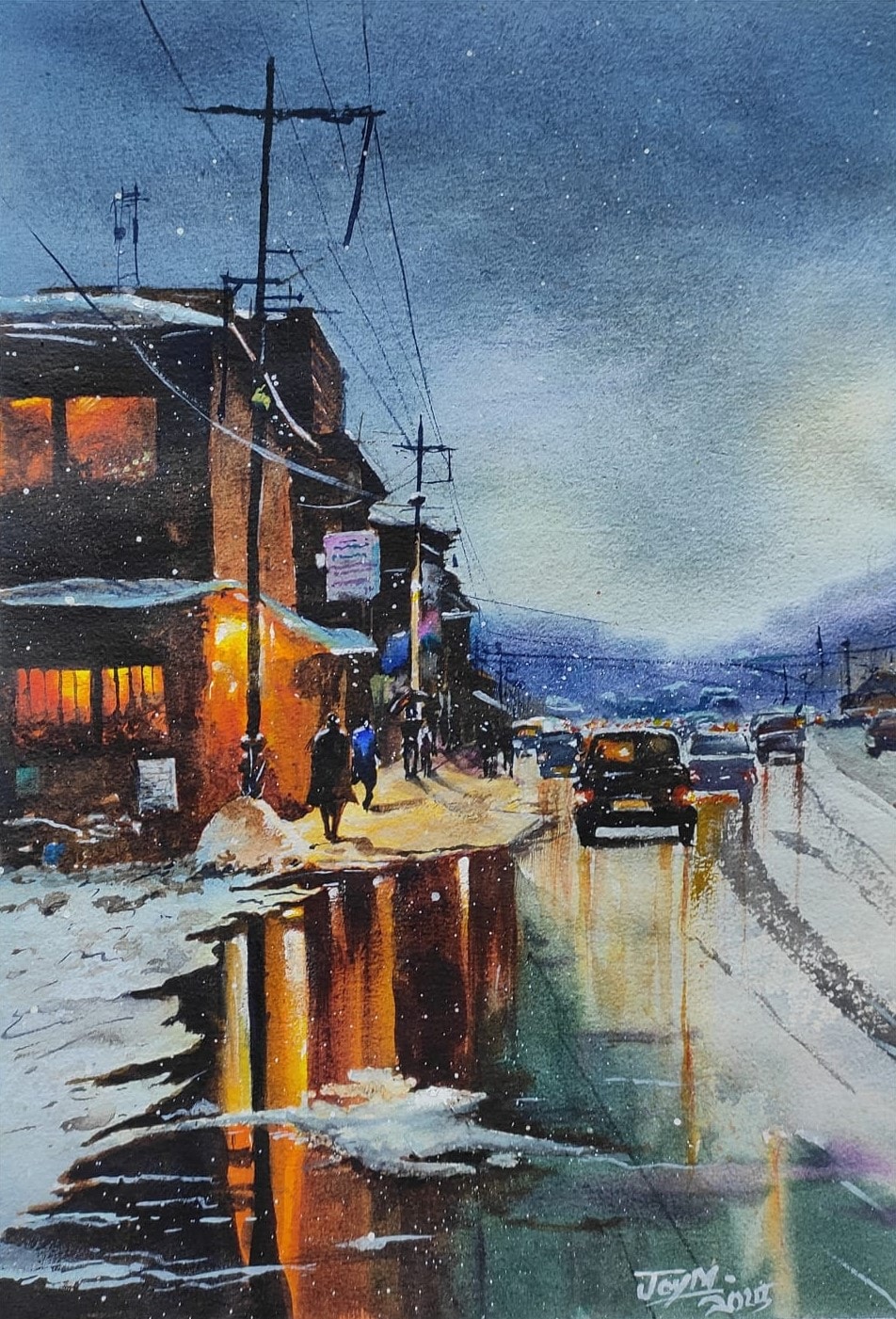
A watercolor painting of a snowy hill town street at dusk, and the monologue of a mind that was always alone. What Sherlock Holmes might have thought, walking home through falling snow, if Watson had never existed. Original watercolor by Joy Mukherjee, Kolkata, 2025. Sold to a private collector in the United States.
By Joy Mukherjee — self-taught watercolor artist, Kolkata. Exhibited at Indian Art Carnival, Shantiniketan 2025.
A Signal from the Past
The note arrived at seven in the morning.
No envelope. No postmark. Slipped under the door with the kind of precision that is itself a message, a reminder that locks are opinions and distance is a formality when the person who wants to reach you has decided to do so. I did not need to read the handwriting to know who had written it.
The game has changed. You will find the pieces where you left them. Do not be late.
Moriarty. Again.
I set it on the mantelpiece, made tea I did not drink, and spent the next four hours in a room that smelled of cold ash and old books, turning the problem over in my mind the way you turn a stone that might be covering something or might be covering nothing at all. By noon I had enough. I put on my coat, went out into the snow, and did not return until the sky had gone the colour of a bruise.
The Street at the End of Dusk
A hill town in winter does something particular to a street.
The cold presses the buildings closer together, or seems to. The shop fronts lean slightly toward the pavement, their windows lit from within, the amber light spilling out across the accumulated snow like something warm trying to survive in hostile country. The mountains at the far end of the road have gone the same blue as the sky, and the boundary between where the peaks end and the air begins has ceased to be meaningful. Everything above a certain altitude is simply dusk.
I walked this street for the third time that evening and noted, as I always note, the things that people moving through a place do not bother to see.
The telegraph wires strung between the poles caught the light from the shop below and held it for a moment, a faint amber thread suspended against the blue-grey of the sky. The cars passing on my right left thin arcs of spray where their wheels met the wet surface of the road. The snow here was not the clean white of a postcard. It was the grey-edged, traffic-compressed, half-dissolved snow of a working street, honest in the way that only used things are honest.
Two figures moved ahead of me on the pavement. I knew from their gait and the angle of their shoulders that they were cold, in a hurry, and not speaking to each other. A couple, then, in the particular silence of an argument not yet finished. The figure in blue carried something under one arm. A package. Rectangular. Purchased, not brought from home. Someone had bought something today that they had not planned to buy, which means something had gone unexpectedly well, or unexpectedly badly.
I catalogued this and filed it and kept walking.
The ground in front of me was extraordinary. I do not use that word loosely. The wet surface of the pavement held the amber of the shop window, the cold white of the street lamp, and the passing red of a taillight in a single pooled reflection, three light sources collapsing into each other in the standing water between drifts of compressed snow. The world existed twice on this street. Once above, in the cold air and the falling flakes and the mountains going invisible in the distance. Once below, in the trembling amber mirror that the street had made of itself.
I have always preferred the reflected version of things. It is less certain, and more honest.
The Problem with Moriarty
People assume the challenge Moriarty poses is intellectual. They are wrong, or rather they are only partially right, which in my experience is the most dangerous kind of wrong.
The intellectual problem is solvable. It requires time and the right variables and the willingness to sit with an incomplete picture long enough for the missing pieces to make themselves visible. I am good at this. I have always been good at this. The mind, properly organized, is an instrument of considerable precision, and Moriarty knows this, which is why he does not waste his challenges on purely intellectual terrain.
What Moriarty does is subtler and considerably more destructive. He designs situations in which the solution requires a witness.
Not assistance. Not additional manpower. A witness. Someone who observes the solver solving, who confirms that the solution, once reached, is real and not a private hallucination. Someone against whom the reasoning can be spoken aloud and tested.
He does this because he knows that without it, the solution sits in a closed room and makes no sound.
I walked to the end of the street and stood for a moment watching the cars move through the intersection below, their headlights doubling in the wet road, and I thought about this. About what it costs to reach a conclusion and have no one to tell it to. About the particular silence that follows a solved problem when the room is empty.
Moriarty does not want to defeat me. He wants to make me understand that winning alone is a kind of losing.
He may have a point.
What Watson Was
I have thought about this more than I would admit to anyone, which means I have thought about it constantly.
There is a version of me that existed before the question of Watson became relevant. That version moved through the world at high speed, solved what was placed in front of it, and felt nothing particularly troubling about the lack of an audience. The work was the thing. The conclusion was the thing. The empty room was simply the room.
Then at some point the empty room began to feel like a specific absence rather than a neutral condition. This is the kind of change you do not notice until it is already complete.
Watson was not a sounding board. That is the common mistake, to reduce him to a function. He was not the person I explained things to so that I could hear myself think. He was something more inconvenient than that.
He was the reason the explanation needed to exist at all.
When I work alone, the deduction is complete the moment it arrives. It is a closed circuit, self-confirming, inaccessible to anyone else. When there was someone to tell it to, the same deduction had to become language. It had to leave the internal register and enter the shared one. And in that translation, something happened that could not happen any other way. The thought became real in a sense that a thought held only in one mind cannot be.
I do not believe in sentimentality. But I am precise enough to call a variable by its correct name.
Watson was the translation.
Without him, I speak the conclusion and the street says nothing back.
The Particular Cruelty of Reflection
The snow had begun again by the time I turned back toward home.
Finer than before, almost more mist than snow, the kind that does not accumulate but only adds to the general softening of things, the way grief accumulates in someone who does not acknowledge it. The shop on my left had its lights fully on now, every window a rectangle of orange warmth, the kind of warmth that is specifically for people who are inside it and not for those standing in the street.
I stopped and looked at the reflection in the pavement for what was probably an unreasonable amount of time.
This is what I saw: a street that was also an inverted street. Buildings that existed both above and below. A figure in the reflected version, standing where the reflected light pooled most thickly, in the place where the amber of the windows and the white of the lamp and the cold blue of the sky all dissolved into each other without any clear boundary. The reflected version of the street had no hard edges. The reflected version was all transition.
I have noticed that the version of anything held in reflection is softer than the original. The colours bleed into each other. The lines that are crisp in the physical world become uncertain in the water. A car that is a definite object passing on a definite road becomes, in its reflection, a smear of red light moving through orange and blue.
Moriarty understands reflection better than I do. That is the honest assessment. He knows that the echo of something is often more revealing than the thing itself. He has built his challenge around the echo, around what the problem looks like when you are standing in the street looking down at the version of it that has no hard edges.
The snow kept falling. The amber kept burning in the windows above. The mountains at the end of the road had gone completely, absorbed into the blue of the evening, present only as a slightly darker suggestion at the horizon.
I had the answer. I had known it since three that afternoon.
The room would be empty when I arrived home. No one would ask me what I had found. The conclusion would sit in the silence and confirm nothing.
I walked on.
The Painting
I was not thinking about Sherlock Holmes when I painted this.
I was thinking about a street in a hill town at the exact hour when the day gives up and the evening takes over, when the cold has been present long enough that it stops being news and starts being simply the condition of the world. I was thinking about the extraordinary fact of amber light in a blue hour, about the way a lit window in winter is almost aggressive in its warmth, the way it insists on itself against everything the sky is doing.
And I was thinking about the figure on the pavement. The one walking away from the viewer, coat pulled close, moving at the pace of someone who has finished something and has not yet decided how to feel about it.
I did not know who that figure was when I painted it. I know now.
Reflections on Snowy Street at Dusk was made in October 2025, on 10 by 14 inch watercolor paper. The sky came first: a wet-on-wet wash of Prussian blue and neutral tint, dropped into a pre-wetted surface and allowed to granulate freely as it dried. The mountain range in the background arrived the same way, pressed in while the sky was still damp, the pigment bleeding upward slightly into the wet blue above it, softening the boundary between peak and air the way the actual boundary softens at dusk.
The buildings on the left were the most demanding passage. The challenge with amber light in a predominantly cool painting is saturation. Push the orange too far and it becomes garish, a stage effect rather than a window. Hold it back too much and you lose the warmth entirely, and with it the whole emotional logic of the composition. I worked this passage in three separate sessions across two days, letting each layer dry completely before committing to the next, building the warmth slowly rather than all at once.
The reflections in the foreground were the last element and the most technically risky. Wet pigment dropped into a surface that was almost but not completely dry, allowing the amber to bleed into the blue-grey of the compressed snow in the way that light bleeds in water. I lifted the brightest passages with a dry brush while the wash was still workable, pulling the lamp post's reflection upward out of the wet pigment. The result is not a reflection I designed. It is a reflection the water designed, following physics, finding the form the surface allowed.
What makes watercolor unique is precisely this: the most alive passages in the painting are the ones where I set up the conditions and then let go.
Two Worlds in One Street
There is a structural logic to this painting that I understood only after it was finished.
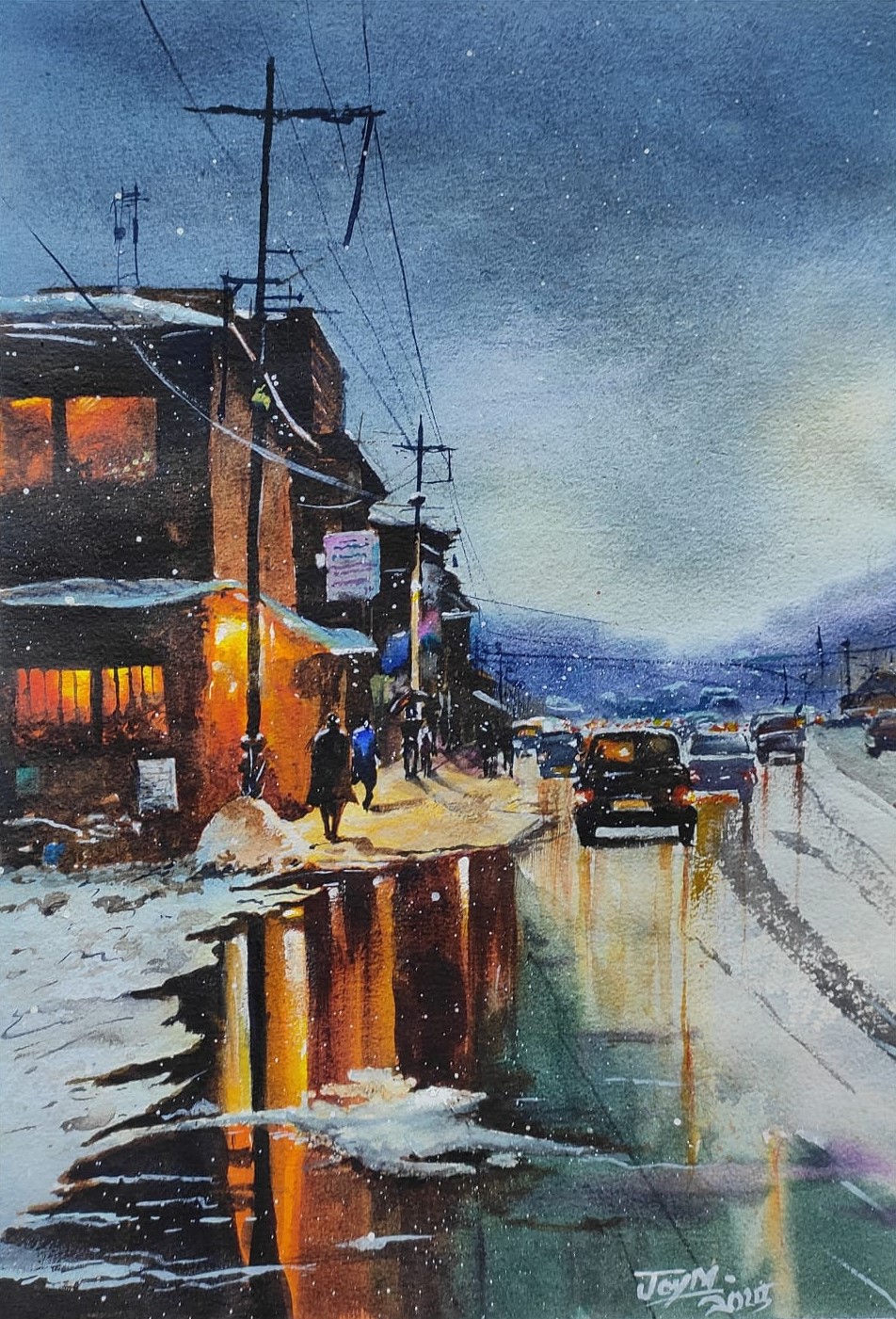
It exists in two registers simultaneously. The upper half is the physical world: the cold sky, the buildings with their lit windows, the power lines crossing the frame, the figures on the pavement, the mountains disappearing into dusk. This is the world of facts, of objects, of things as they are.
The lower half is the reflected world: the same street, dissolved. The same amber, made uncertain. The same poles and lights, pulled downward into the wet surface and stretched and softened until they become something between a fact and a feeling.
Most paintings choose one register or the other. This one refuses to. The foreground reflection takes up as much of the canvas as the street above it, and it demands equal attention. The painting will not let you look only at the physical world. It insists on the echo.
This is why, looking at it later, I thought of someone alone with a conclusion he cannot share. The deduction is the upper half: precise, complete, real. The silence that follows it is the reflection below: the same thing, made uncertain, made without edges, made beautiful in a way the original cannot be because the original is too hard and too finished to breathe.
The figure on the pavement is between the two. Walking from one toward the other, coat pulled against the cold, in no particular hurry because there is no particular reason to arrive.
This is what the painting knows that I did not know when I was making it.
A Collector in the United States
Reflections on Snowy Street at Dusk left Kolkata in November 2025. It was purchased by a private collector in the United States approximately four weeks after it was completed.
The buyer found the work through this website. No gallery. No agent. No intermediary. A direct transaction between an artist in Kolkata and a collector in America, the painting packaged between rigid boards with a moisture barrier, shipped internationally, tracked, and confirmed delivered.
I mention this not to advertise a sale but because it matters to the painting's story. This is an original watercolor that sold internationally within weeks of completion, to someone who had no prior knowledge of my work, who found it through a search, looked at it on a screen, and decided it was worth having on a wall in a country where snow falls differently, where the hill town streets look nothing like this one, but where the feeling of amber warmth against a cold sky is apparently universal.
That is the thing about certain paintings. They do not require a shared geography.
The collector knew, as every serious buyer of original work knows, that original watercolor paintings carry something a print cannot: the actual surface, the actual granulation, the actual amber that bled into the wet paper and was fixed there permanently by a specific afternoon in October 2025. The painting they received was not a reproduction of a moment. It was the moment itself, materialized in pigment and cotton.
The painting is now sold and no longer available. For works that are currently available, the landscapes collection includes Silent Harbor at North, Where the Light Waits, A Snowy Morning in Kedarnath, and Morning in Kumaon. The narrative collection includes The Last Charge, Remnant, and While the Cities Were Burning. For collectors outside India interested in international shipping, the process is straightforward. You can read the full guide on how to buy original watercolor paintings online or get in touch directly.
One Last Thing About the Street
I have thought about that figure on the pavement more than the painting probably warrants.
He is not lost. His posture is too deliberate for that. He knows where he is going. He has known for some time. But there is something in the set of his coat, in the fact that he is alone in a frame full of people and cars and lit windows, that suggests arrival is not entirely the point.
Sometimes the walk is the thing. The cold air and the amber light and the mountains going invisible behind you and the particular silence of snow falling on a street that has decided, for this hour, to be beautiful. The conclusion sitting in your pocket like a carved wooden horse, waiting for a room that will be empty when you get there.
You count the steps. You keep walking.
The reflection follows you all the way home.
About the Artist
Joy Mukherjee is a self-taught watercolor artist based in Kolkata, India. Working primarily in landscape and narrative subjects, their paintings have been exhibited at the Indian Art Carnival Season 7, Shantiniketan (December 2025), and are held in private collections across India and the United States. Reflections on Snowy Street at Dusk was the first painting in the series to reach an international collector. You can follow their process on Instagram or browse the full portfolio at artbyjoy.shop.
Browse the original watercolor landscapes, explore the narrative collection, read about what makes watercolor unique as a medium, or get in touch to discuss a commission or international shipping.
Recommended Reading
- What Makes Watercolor Unique — The physics, the techniques, and why the medium does not forgive.
- Why Original Watercolor Paintings Feel More Alive Than Prints — The optical difference between originals and reproductions.
- How to Buy Art Directly From an Artist — Why direct purchase gives you better provenance and better prices.
- How to Buy Original Watercolor Paintings Online — A complete guide for international collectors.
Frequently Asked Questions
What is the painting Reflections on Snowy Street at Dusk about?
It is an original watercolor painting made in Kolkata in October 2025, depicting a hill town street at the transition between day and evening. Snow has fallen and is still falling lightly. Shop windows on the left pour amber light across the pavement, which holds their reflections in the wet surface below. Figures move through the cold. Cars pass on the road. The mountains at the end of the street have dissolved into the dusk sky. The painting exists simultaneously in two registers: the physical world above and its softened, uncertain reflection below. The story written around it imagines the scene through the eyes of Sherlock Holmes, walking alone through the kind of evening that makes solitude feel like both a condition and a choice.
Is this painting available for purchase?
No. Reflections on Snowy Street at Dusk was sold to a private collector in the United States in November 2025, approximately four weeks after it was completed. It is no longer available. For currently available originals, browse the landscapes collection or the narrative collection. For commission enquiries in a similar style, visit the contact page.
Was this painting sold internationally? How does that work?
Yes. The painting was purchased by a collector in the United States through this website, shipped from Kolkata with professional packaging, tracked internationally, and confirmed delivered. International sales from this studio work through direct payment via Razorpay, Stripe, or bank transfer, with the painting packaged flat between rigid boards inside a moisture barrier, and shipped via a tracked international courier service. For a full breakdown of the process, read how to buy original watercolor paintings online.
What techniques were used in this painting?
The sky and background mountains were painted wet-on-wet, pigment dropped into a pre-wetted surface and allowed to granulate and bleed as it dried. The buildings and street elements were painted wet-on-dry for crisp edges. The amber window passages were built in three separate layers across two days, each layer dried completely before the next was added. The foreground reflections were the most technically complex element: wet pigment dropped into a near-dry surface, the brightest passages lifted with a dry brush while the wash was still workable. For a detailed explanation of these techniques, read what makes watercolor unique.
What are the dimensions and materials of this painting?
10 inches by 14 inches on cold-pressed watercolor paper. Professional-grade watercolor pigments. No digital assistance or underpainted guides. Signed and dated by the artist. A Certificate of Authenticity accompanied the work on sale.
Why is the reflection so prominent in this painting?
The reflection occupies roughly the lower third of the composition and is treated as a subject of equal weight to the street above it. This was a deliberate structural choice: a dusk street after snowfall exists in two simultaneous registers, the physical world and its echo in the wet surface below. The reflected version is softer, less certain, and differently beautiful from the one above it. Giving the reflection equal weight is a way of acknowledging that the echo of a thing sometimes reveals more about it than the thing itself.
How does Joy Mukherjee approach urban and street scenes in watercolor?
Street scenes in watercolor require managing the tension between warmth and cold, between controlled edges and atmospheric softness. In this painting, the warm amber of the shop windows had to be built slowly and precisely to avoid overwhelming the cool blues that dominate the rest of the composition. The wet street surface required the most technically risky work: foreground reflections where wet pigment was dropped into a near-dry wash, the result depending on a narrow window of surface moisture that changes within minutes. Other available urban and atmospheric works include Morning in Kumaon and Where the Light Waits.
Can I commission a painting in a similar style to this one?
Yes. Joy accepts commissions for original landscape and atmospheric watercolor works, including urban street scenes, snowy environments, and dusk and evening light studies. Visit the contact page to discuss subject, dimensions, timeline, and pricing. International shipping is available.
What other paintings have been sold internationally from this studio?
Reflections on Snowy Street at Dusk was among the first works from this studio to reach an international collector. Since then, paintings from both the landscapes collection and the narrative collection have been shipped to collectors outside India. If you are an international collector interested in acquiring an original, the buying guide covers every step of the process, and buying directly from the artist remains the most transparent and cost-effective route.
Why is the figure in the painting alone?
The figure on the pavement is alone because the painting is about the particular quality of solitude in a public space at a certain hour. A busy street at dusk is full of people who are all, in their own way, moving through a private experience inside a shared one. The figure is not isolated from the world around it. It is simply moving through the world at its own pace, in its own direction, carrying whatever it is carrying. The Sherlock Holmes story written around the painting extends this quality: a mind accustomed to working alone, on a street that doubles itself in the wet snow below, returning home to a room that will ask no questions.
Written by Joy Mukherjee
Joy Mukherjee is a watercolor artist who paints landscapes, village scenes, and atmospheric moments using transparent watercolor on archival cotton paper. Her work is born from memory, light, and atmosphere.