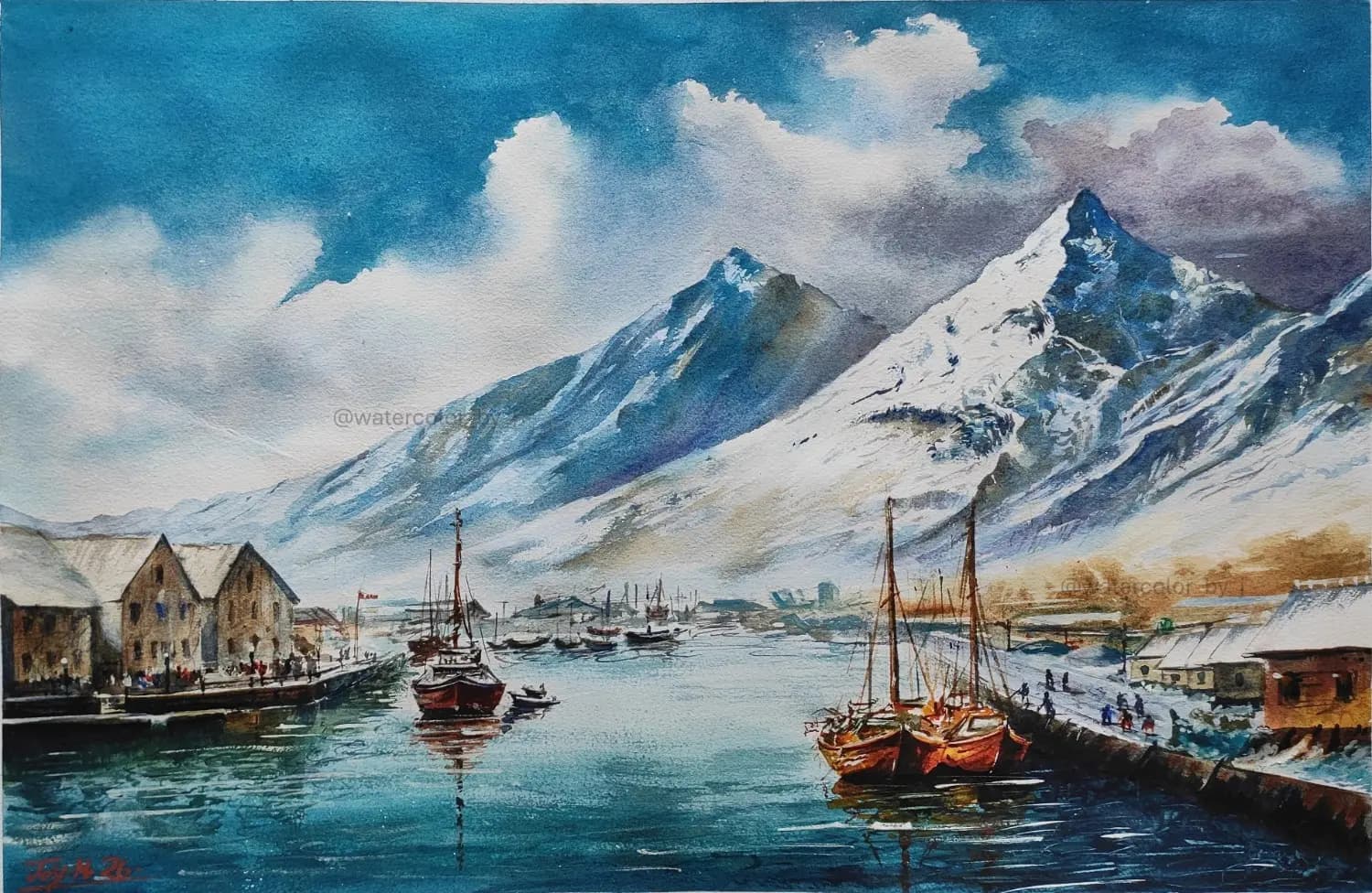
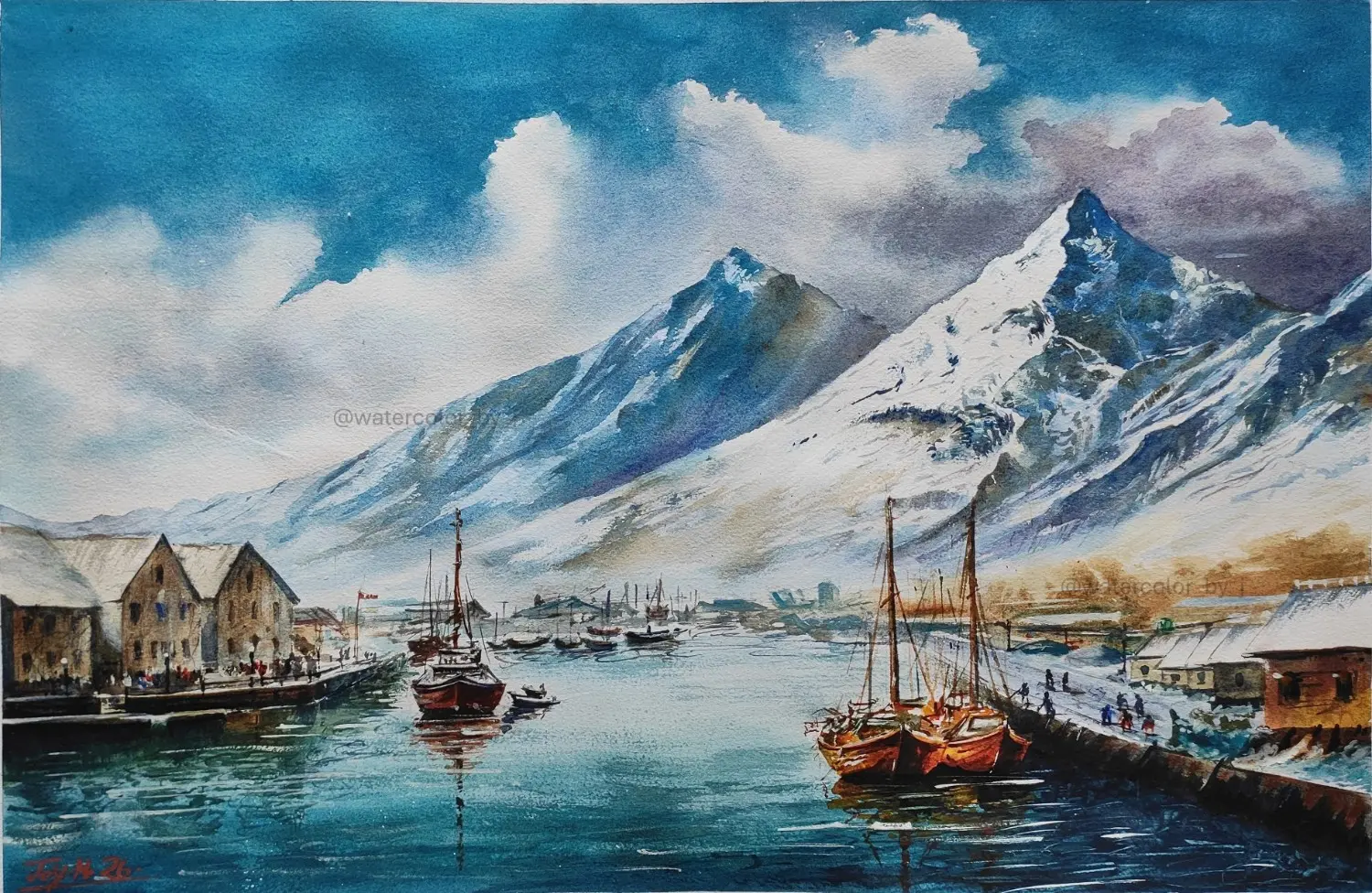
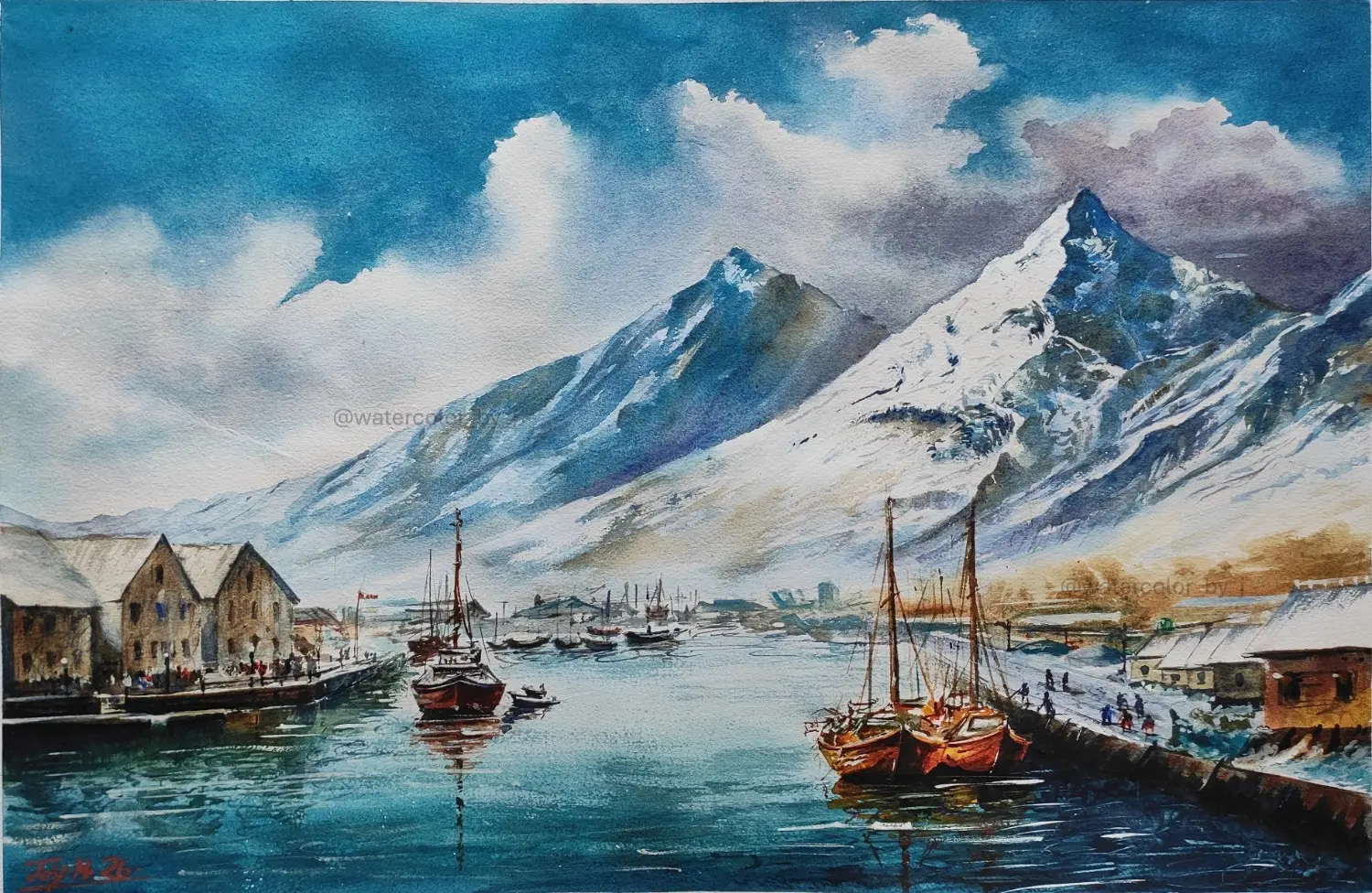
A watercolor painting of a Scandinavian fjord harbor at dawn, and the story of a small girl in a pre-industrial Norwegian town counting the days until her father's trading ship came home. Original harbor watercolor painting by Joy Mukherjee Kolkata, 2026.
By Joy Mukherjee, watercolor artist, Kolkata.
Before the age of telegraphs, before the postal routes had reached every fjord and inlet of the northern coast, a child's understanding of time was entirely different from ours.
A month did not tick by in notifications and calendar alerts. A month was the slow burning down of candles. It was the number of times you had helped your mother salt the fish, the number of Sundays you had sat in the cold wooden pew of the church and not understood the sermon but stared at the light coming through the high window and wondered if your father could see the same sky from wherever the water had taken him.
A month was thirty mornings of waking and listening, before your eyes had even opened, for the sound of boots on the dock.
The Town of Solvåg
The town I have imagined for this painting has no place on any map. I have called it Solvåg (sun inlet), a small name for a small place. A cluster of stone-walled warehouses and timber houses pressed close to the water's edge, the way buildings lean together in cold places, as if for warmth. A Lutheran church on the hill behind it, its white walls always faintly grey with sea spray. Two taverns. A cooperage. A chandler's shop that also sold rope, dried beans, and, when the season allowed, small paper-wrapped sweets from Bergen.
The harbor itself was the town's reason for existing. Everything began and ended at the water. The men who worked the trading routes north toward Tromsø and south toward Stavanger and across the open sea to the ports of the Dutch were not adventurers. They were not heroes. They were fathers and husbands and younger brothers doing the only work the land would allow, returning each time a little more weathered, a little more quiet, carrying in their sea-bags the small gifts that said what the cold northern temperament rarely permitted them to say out loud.
The Girl at the End of the Dock
Her name was Ingrid. She was seven years old, and she had been waking before her mother every morning for the past four days because someone in the town had said the Nordstjerne had been sighted rounding the headland at Utøy, and that meant it would reach Solvåg before the week was out.
She wore her good wool coat, the dark blue one with the brass buttons her father had brought from a Dutch port the winter before. She had put it on herself before her mother was awake, struggling with the buttons in the cold dark of their house, because she wanted to look like herself when he saw her, not like a child who had been dressed by someone else.
The harbor in the early morning was already busy. It was always busy. The fishermen who worked the closer waters had left before dawn and were returning now with their catch, the keels of their small boats low and heavy, the gulls shrieking overhead in a frenzy of anticipation. The air was sharp with the smell of it: fish and salt and the particular iodine heaviness that settles over every northern harbor and works its way into the timber of the buildings, the wool of the coats, the hair of every child who grows up within a mile of the water. You do not notice it when you live there. You only notice it when you have been away, and you come back, and the smell of the sea hits you at the dock and something in your chest unlocks.
Ingrid noticed nothing. She was looking at the mouth of the fjord.
What a Month Feels Like When You Are Seven
Here is the truth about missing someone when you are a child: you do not miss them continuously. That is the mercy and the cruelty of it. You go whole hours without thinking of your father, absorbed entirely in the world of your own games and hunger and small grievances, and then something catches you: the particular way a man on the street holds his hat against the wind, or the shadow of a tall mast crossing the cobblestones of the dock, and it comes back all at once.
Not sadness, exactly. Heavier than sadness. The specific weight of an absence.
Ingrid had memorized his face the way you memorize a prayer, not because you are afraid of forgetting the words, but because you need something to hold onto in the dark. The roughness of his jaw when he bent to kiss her cheek. The smell of him, wood smoke and tar and something else she could not name, something that was just him. The particular sound of his laugh, which was not loud but which she could always hear across a crowded room.
For thirty mornings she had opened her eyes and he was not there.
This morning, she was at the dock before the light had fully come.
The Nordstjerne
The trading vessel Nordstjerne (the North Star) was not a beautiful ship by anyone's measure. It was a cargo hulk of perhaps sixty feet, broad-beamed and deep-drafted, built for capacity rather than elegance, its hull dark with pitch and age, its sails the color of old cream, patched in three places with fabric of a slightly different shade. It carried dried fish north and brought back timber, cloth, iron fittings, and the occasional luxury, a bolt of printed cotton or a small cask of something stronger than the local aquavit, to the merchants of Solvåg.
To Ingrid, it was the most beautiful thing in the world.
She saw the mast first, appearing above the headland slowly, the way a thought emerges: uncertain at first, then undeniable. Then the hull. Then the sails, backing as the helmsman turned into the harbor entrance, reading the morning wind. The Nordstjerne moved without urgency, in the way of working ships that have made a crossing ten thousand times and see no need for theater.
On the dock around her, people had begun to gather. A wife with an infant balanced on her hip. Two older men waiting for the cargo manifest. A boy not much older than Ingrid who had apparently decided that running in circles was the appropriate response to excitement.
Ingrid stood still.
She was looking for one shape among the figures visible at the ship's rail.
The Painting
I was not trying to paint this story when I made Silent Harbor at North. I was trying to paint a morning.
But that is how certain paintings work: you try to paint a place, and a feeling arrives and refuses to leave. I was painting the blue of a fjord at the edge of winter, the snow-covered mountain behind the harbor, the amber of the wooden boats against the cold water. I was painting the particular quality of northern morning light, which is low and precise and seems to illuminate things from the side rather than from above, the way a candle held close to a face reveals its texture.
And then the people came. Small figures, barely indicated, moving along the stone quay. A harbor in its morning routines. And I thought: who are these people? What are they waiting for?
They are always waiting for something, in harbor paintings. A tide. A cargo. A ship.
Someone is always waiting for a ship.
This is an original watercolor painting, painted in 2026, signed and dated, at 15 × 22 inches and one of the larger works in the landscapes collection. If you would like to own it, it is available here.
What He Carried Home
Bjørn, Ingrid's father, was thirty-four years old. He had been making the northern trading run for eleven years. He was not a sentimental man in the way that word is sometimes used. He did not cry, he did not speak often of what he felt, he kept his interior life as carefully sealed as the cargo barrels he stowed in the hold.
But on this particular crossing, he had done something he had never done before.
On the third week out, somewhere in the cold grey waters north of the Lofotens, he had asked the ship's carpenter, a man named Torstein who had a talent for small things, to carve a figure from a piece of off-cut pine. A small horse. The kind children in the towns painted red and kept on windowsills.
He had kept it in his coat pocket for the last week of the voyage, taking it out sometimes in his bunk at night, rubbing his thumb along the carved mane in the dark.
It is the hardest thing, to be a father at sea. Not the storms, because the storms you can act against. The hardest thing is the ordinary morning, the calm water, the routine of the watch, and the knowledge that somewhere on shore a child is waking up and going about her day without you, growing, changing, becoming someone slightly different than the child you left, and you are missing it, all of it, and there is nothing to be done.
You stare at the water. You put your hand in your pocket.
You count the days.
A Moment, Not a Story
I want to be clear about what this painting is and what it is not.
It is not a story with a resolution. It does not tell you what happened when the ship docked, whether Ingrid found her father at the rail, whether he lifted her up the way she had been imagining for thirty days. It does not show you the reunion, the small carved horse changing hands, the particular quality of a child's relief when the worst imagined thing does not happen.
It shows you the moment before all of that.
The harbor in its morning work. The cold air and the smell of fish and the low sun on the water and the mountain watching from behind, indifferent and permanent and magnificent. The figures on the quay, small against the scale of the landscape, significant in ways the landscape does not record.
An insignificant family in a small town by the fjords, about to be made whole again.
That is the whole painting. That is enough.
Why Watercolor
There is something fitting about watercolor for this kind of subject. The northern light, that low, raking, cold-edged light that defines the Scandinavian morning, is not a light you can force. It has to be allowed. Watercolor, more than any other medium, asks the painter to let go. You wet the paper, you introduce the pigment, and then the paint does what it does, bleeding into the wet, settling where physics takes it, finding its own edges.
The snow on the mountain in this painting was not painted. It was preserved, the white of the paper held back while the blues and grays of the peak were built up around it. The reflection in the harbor water was pulled out of wet pigment with a dry brush, the light arriving not through addition but through removal.
Watercolor paintings feel more alive than prints because they are made the way certain moments happen: quickly, with commitment, without the possibility of taking it back.
We Are Small Here
The mountains in this painting are not decorative. They are doing something important.
They are reminding you of scale.
Every harbor painting I have ever loved does this: it places the human figures in right proportion to the world around them. These people, going about their morning, waiting for their ships, living their lives of cold and work and occasional joy, they are not the center of the universe. The mountain has been here for ten thousand years. The fjord was carved by a glacier that did not know and did not care what any of us would build here.
And yet. The small figures on the quay are the reason the painting exists. The mountain is context. The people are the subject.
This has always been true. It will always be true.
A species remarkable enough to look at a mountain and feel something is also remarkable enough to stand at the end of a dock in the cold and wait for someone they love.
Those two things are not unrelated.
Silent Harbor at North is an original watercolor painting on watercolor paper, 15 × 22 inches, signed and dated 2026 by Joy Mukherjee. Browse the full landscapes collection or get in touch about a commissioned piece.
Recommended Reading
- Why Original Watercolor Paintings Feel More Alive Than Prints — Why the medium itself matters.
- How to Buy Original Watercolor Paintings Online — A guide for new collectors.
- What Makes Watercolor Unique — On the medium's unpredictability and honesty.
Frequently Asked Questions
What is the painting Silent Harbor at North about? It is an original watercolor painting made in Kolkata in 2026, depicting a Scandinavian fjord harbor at dawn — inspired by the pre-industrial coastal towns of Norway. Snow-capped mountains rise behind the harbor, wooden trading ships rest at anchor, and small figures go about their morning on the stone quay. The painting is about scale, stillness, and the quiet dignity of ordinary life in an extraordinary landscape.
Is this painting based on a real place? No specific location was the direct reference, though the painting is strongly inspired by the character of small Norwegian fjord towns — the kind found along the Lofoten coast, the Hardangerfjord, or the villages north of Bergen. The snow-covered mountain, the stone quayside, the working harbor, the color of the morning light — these are drawn from the visual language of Scandinavia rather than any single place.
What is the style of this painting? Representational watercolor landscape painting, with loose, atmospheric brushwork that prioritizes mood and light over photographic detail. The technique uses wet-on-wet washes for the sky and mountain snowfields, wet-on-dry for the harbor structures and vessel detail, and careful negative-space preservation to achieve the snow highlights and water reflections. It sits in the tradition of the great maritime landscape painters, but is painted with a contemporary looseness.
What period does this painting depict? The painting is set in a pre-industrial Scandinavian harbor — roughly the 17th to early 18th century, before steam power transformed the fishing and trading economies of coastal Norway. The wooden cargo vessels, the stone warehouses, the hand-worked dock, and the absence of any industrial infrastructure all point to this earlier era, when small fjord towns lived entirely by the rhythm of the sea, the trade routes, and the seasons.
How large is this painting? Silent Harbor at North is one of the larger works in Joy's landscapes series — 15 × 22 inches on watercolor paper. This larger format allowed the sky and the mountain to carry real weight in the composition, giving the small human figures on the quay the correct sense of scale against the landscape around them.
What does the mountain symbolize in this painting? The snow-covered mountain that dominates the upper right of the composition is both literal and thematic. Literally, it is the kind of dramatic peak that rises immediately behind many Norwegian fjord towns, giving the geography its characteristic drama. Thematically, it represents permanence, scale, and the indifference of the natural world to human stories — which makes the small human figures on the quay below all the more significant by contrast.
Is this painting available for purchase? Yes. Silent Harbor at North is an original, one-of-a-kind work on watercolor paper, 15 × 22 inches, signed and dated by the artist. It comes with a Certificate of Authenticity. Visit the gallery page for details or get in touch via the contact page.
What materials were used? Professional-grade watercolor pigments on cold-press watercolor paper, using a combination of wet-on-wet and wet-on-dry techniques. The snow on the mountain peaks was achieved through negative-space preservation rather than white paint — the white of the paper itself is the light. No digital manipulation of any kind.
Who is the artist? Joy Mukherjee is a self-taught watercolor artist based in Kolkata, India. Their work has been exhibited at the Indian Art Carnival Season 7, Shantiniketan (December 2025), and held in private collections across India and internationally. You can follow their process on Instagram or browse the full portfolio at artbyjoy.shop.
Can I commission a painting in a similar style? Yes. Joy accepts commissions for original landscape and narrative watercolor works, including harbor scenes, mountain landscapes, and period-setting compositions. Visit the contact page to discuss subject, size, timeline, and pricing.
What other paintings are similar to this one? Other works in the landscapes collection that share a similar mood — quiet, atmospheric, focused on the relationship between people and landscape — include Lone Fisherman and Sunset, Morning in Kumaon 1, and Quiet Afternoon in the Hills. For narrative works that explore human stories embedded in dramatic settings, see the full narrative collection.
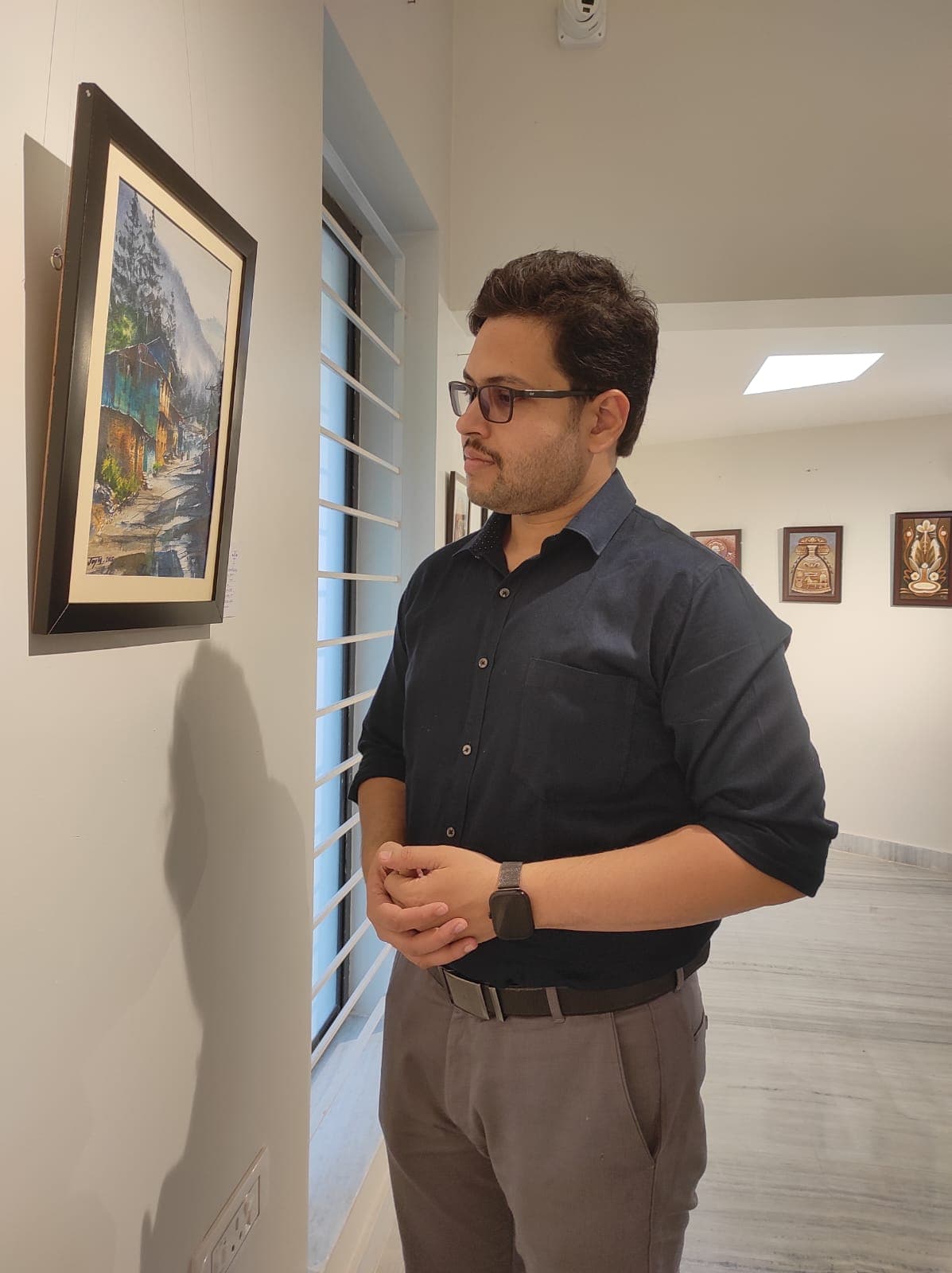
Written by Joy Mukherjee
Joy Mukherjee is a watercolor artist who paints landscapes, village scenes, and atmospheric moments using transparent watercolor on archival cotton paper. Her work is born from memory, light, and atmosphere.