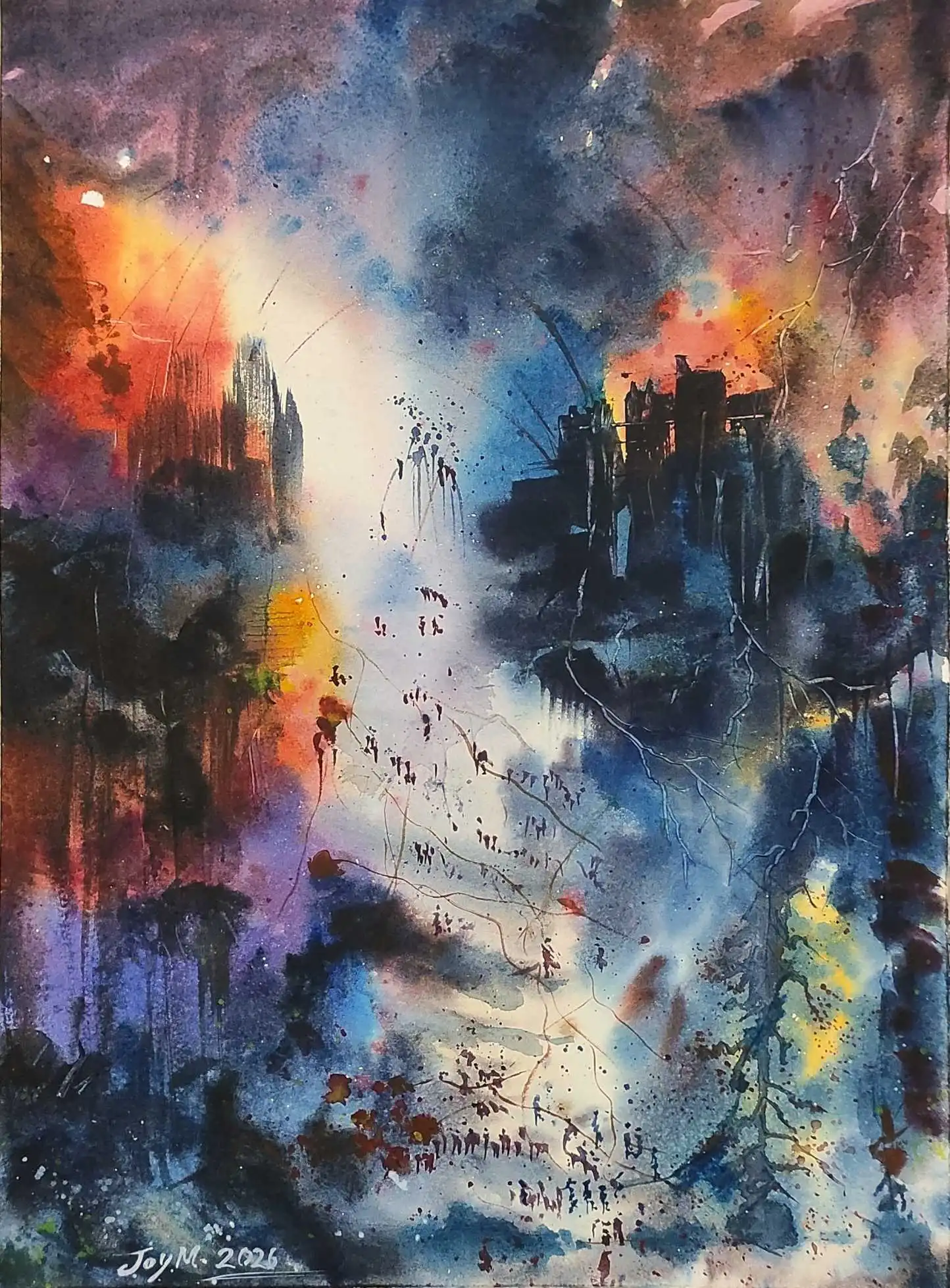
A watercolor painting about civilian suffering in conflict, a species that took a million years to discover fire, and the strange tragedy of being human. Original conflict art by Joy Mukherjee Kolkata, 2026.
By Joy Mukherjee — watercolor artist, Kolkata. Exhibited at Indian Art Carnival, Shantiniketan 2025.
It took us nearly a million years to discover fire.
Think about that. A million years of cold nights, raw meat, darkness and fear — before one pair of hands, somewhere on this ancient earth, learned to coax light from stone. That moment did not just warm a cave. It rewired a species. It was the first time something on this planet looked at the world and decided to change it.
We were extraordinary from the beginning. We just did not know it yet.
The Long Road to Here
From that first flame it took another fifty thousand years to build a wheel. Then a few thousand more for writing, for mathematics, for the idea that the stars could be mapped and the seas could be crossed. And then something accelerated. A steam engine in 1712. Electricity harnessed by 1879. A man on the moon by 1969. A supercomputer in every pocket by the time your grandmother was still alive.
The human brain — your brain — is three times the size of a chimpanzee's relative to body weight. Three times. Our closest cousins on this evolutionary tree, animals of remarkable intelligence and social complexity, and we simply left them behind. Not because we were stronger or faster. Because we could imagine things that did not exist yet and then build them.
We are, by every measurable standard, the most extraordinary accident this universe has ever produced.
And Yet.
We fight over parking spaces.
We fight over which invisible border our grandfather was born behind. We fight over which ancient text holds the correct instructions for a god no one has ever seen. We fight in neighborhood WhatsApp groups, on public buses, in parliaments, in deserts, in cities that took centuries to build and take hours to burn.
The same brain that mapped the human genome, that wrote Beethoven's Ninth, that dreamed up the internet and quantum mechanics and sent a telescope so far into space it can see the birth of stars — that same brain also figured out the most efficient way to make other humans disappear.
We have depopulated ourselves periodically throughout history. Systematically. Deliberately. With extraordinary ingenuity.
The Painting
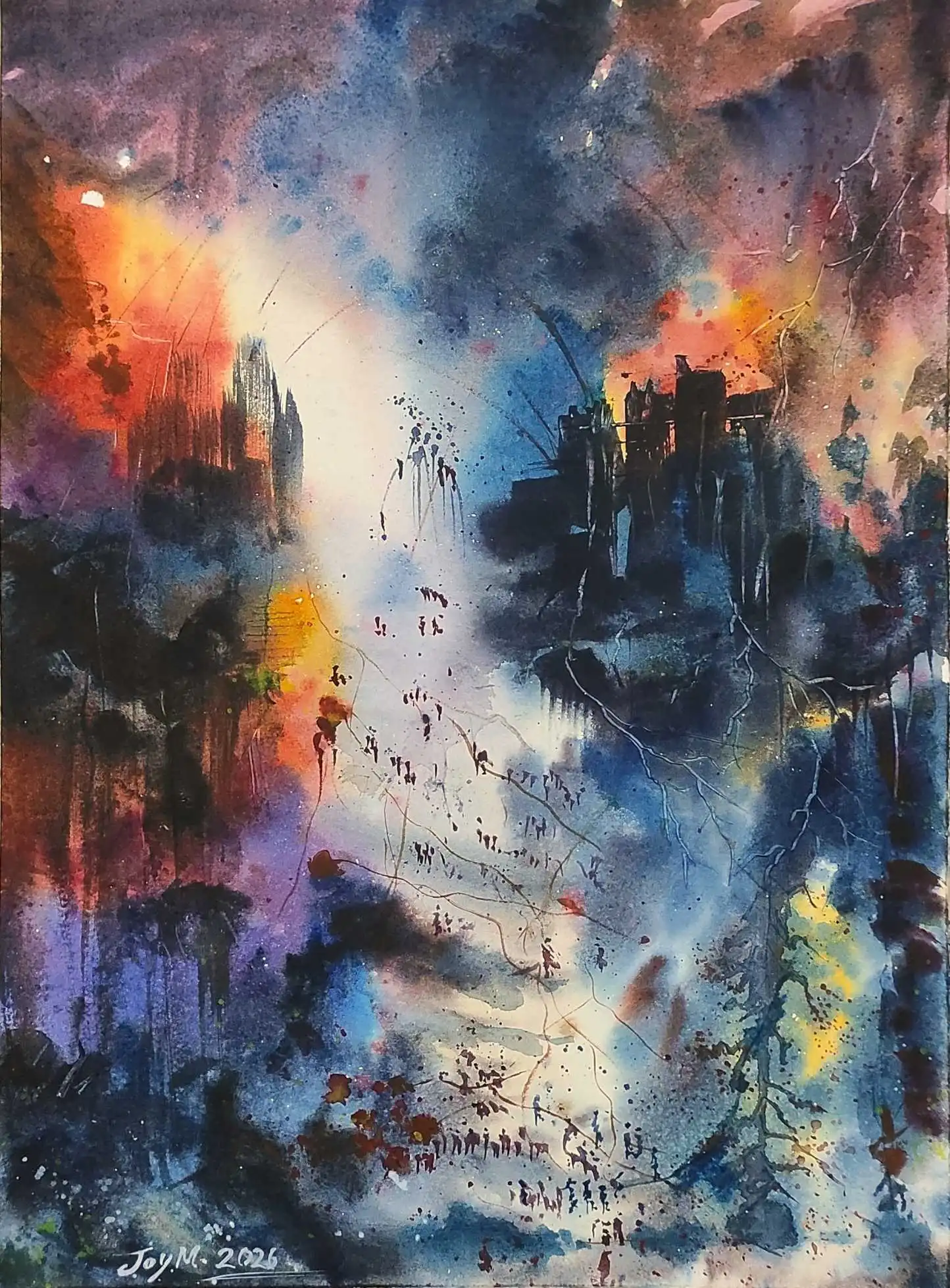
I made While The Cities Were Burning in 2026, in a small room in Kolkata, in March heat that kept drying my paper before I could finish a thought.
I was not trying to make a political painting. I was not picking a side or waving a flag or pointing a finger. I have no interest in that.
I was trying to paint the feeling of watching a news cycle reduce human beings to statistics. Casualties. Collateral. Numbers in a briefing.
The tiny figures in this painting — and they are tiny, intentionally, almost invisible — are not soldiers or politicians or ideologues. They are just people. Moving through smoke and fire and noise that began somewhere far above them in the architecture of power and came crashing down anyway.
They did not start this. They are just in it.
That is the oldest human story there is.
This is an original watercolor painting, signed and dated. One of a kind. If you would like to own it, it is available here.
What Art Is For
Goya painted the horrors of the Napoleonic wars not to take a side but to make you look. Picasso painted Guernica in 1937 not as a military report but as a scream. Art has always been the place where humanity looks at itself without the mediation of politics or profit or propaganda.
This painting is my version of that impulse. Small, personal, made in watercolor on paper in impossible heat. But honest.
If it makes even one person pause before reducing a human life to a headline, it has done its work.
We Are Better Than This
I believe that. Despite everything, I believe that.
A species that can feel grief for strangers, that can make music and mathematics and meaning out of chaos, that can look at a night sky and wonder — that species is not finished. We are not the sum of our worst moments.
But we have to choose. Every generation has to choose. The fire we discovered a million years ago can warm a home or burn a city. That has always been true. That will always be true.
The question is never about the fire.
It is always about the hands holding it.
But we have to choose. Every generation has to choose. The fire we discovered a million years ago can warm a home or burn a city. That has always been true. That will always be true.
The question is never about the fire.
It is always about the hands holding it.
"Where the mind is without fear and the head is held high; where knowledge is free; where the world has not been broken up into fragments by narrow domestic walls —"
— Rabindranath Tagore
While The Cities Were Burning is an original watercolor painting, signed and dated 2026. Browse the full narrative collection or get in touch to discuss a commissioned piece.
Frequently Asked Questions
What is the painting While The Cities Were Burning about? It is an original watercolor painting made in Kolkata in March 2026, focused on the experience of civilians caught in conflict. It is not a political work. It does not take sides. It documents a feeling — the feeling of watching human lives reduced to numbers in a news cycle — through abstract expressionist watercolor.
What style and genre does this painting belong to? The painting sits within Abstract Expressionism and Contemporary Conflict Art. It uses wet-on-wet watercolor technique to create explosive, atmospheric forms, with small figurative silhouettes placed to emphasise the scale of human vulnerability against large forces.
Is this painting available for purchase? Yes. It is an original, one-of-a-kind work on watercolor paper, signed and dated by the artist. It comes with a Certificate of Authenticity. Visit the gallery for details or reach out via the contact page.
What materials were used to make this painting? Professional-grade watercolor pigments on watercolor paper, using wet-on-wet and wet-on-dry techniques, with controlled spattering for texture. No digital manipulation. No prints in this listing.
Who is the artist? Joy is a self-taught watercolor artist based in Kolkata, India. Their work has been exhibited at the Indian Art Carnival Season 7, Shantiniketan (December 2025), and held in private collections across India and internationally. You can follow their process on Instagram or browse the full portfolio at artbyjoy.shop.
Can I commission a painting in a similar style? Yes. Joy accepts commissions for original narrative and abstract watercolor works. Visit the contact page to discuss subject, size, timeline, and pricing.
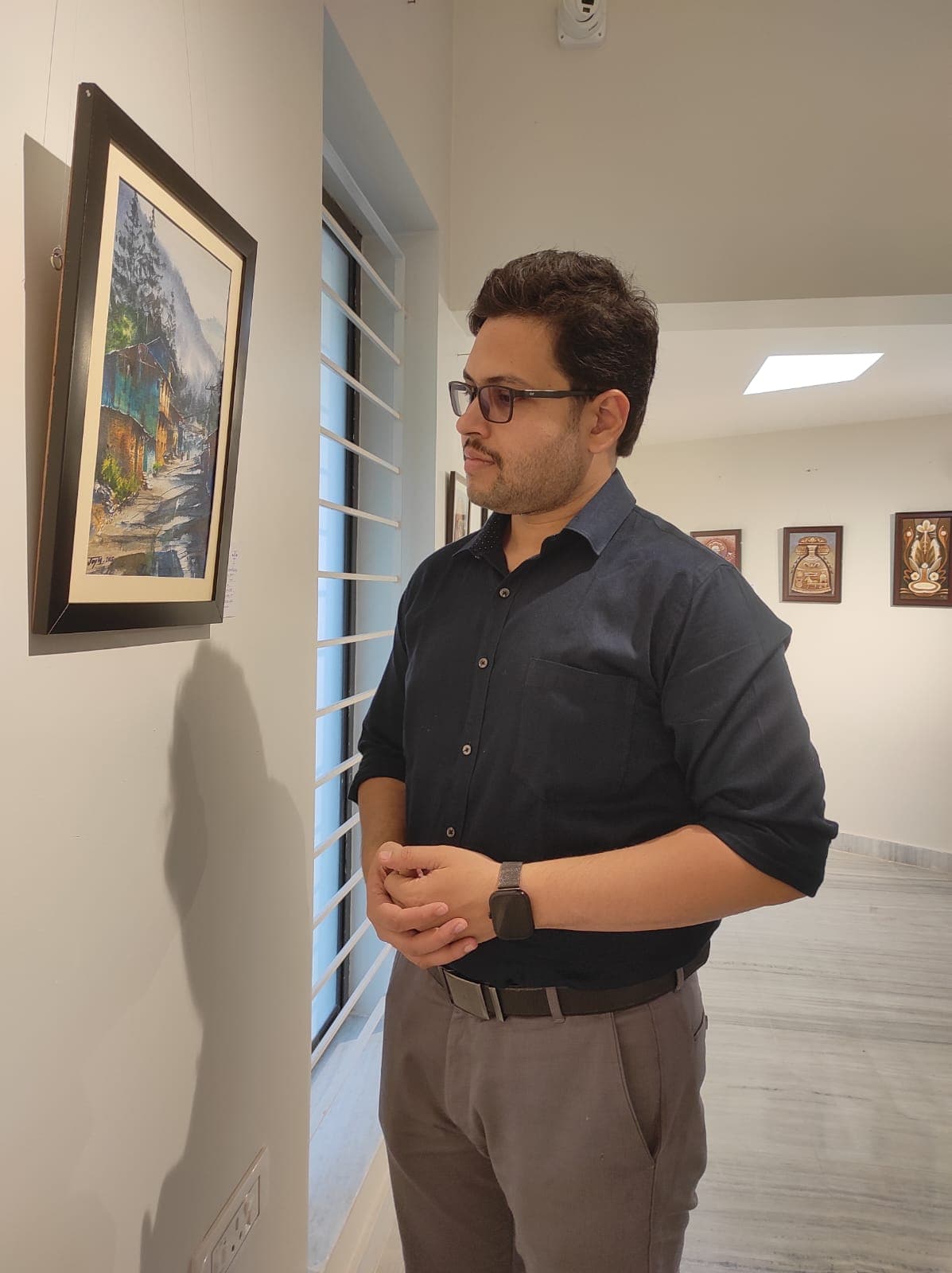
Written by Joy Mukherjee
Joy Mukherjee is a watercolor artist who paints landscapes, village scenes, and atmospheric moments using transparent watercolor on archival cotton paper. Her work is born from memory, light, and atmosphere.
Meet the Artist